


Trve Northern New England Black Metal


Blacklaw Tower
The lands of Blacklaw came into the possession of the Johnstone’s sometime during the 16th century and it was most certainly they who built the tower, outbuildings and barmkin. The tower stands on the edge of a small ravine on the east side of the Evan valley, from where it overlooked and guarded the main road north to the Clyde valley and beyond. On its south side the ground falls steeply down to the Blacklaw Burn, while on the other three sides there are the remains of a complex system of enclosures and secondary buildings, all of which are now reduced to little more than heaps of rubble. It is thus impossible without excavation to relate them with any certainty to the overall chronology of the site. It has, however, been suggested that the enclosure complex is ‘perhaps without close parallel in Scotland’. The largest enclosure, which extends beyond the tower to the northeast and southeast and measures approximately 160 feet square, was surrounded by a wall that varied in thickness from about 4 feet to 7 feet. This was presumably the original barmkin. It was unusual in that along the southeast side, there was a secondary, apparently lower section of wall or wall-walk, 3 feet 9 inches wide, abutting it on the inside, which gave the wall an overall thickness of 10 feet 9 inch at the base. In the east corner of this enclosure there were two buildings, measuring about 40 feet by 19 feet and 19 feet by 15 feet, while running along the southeast wall further west there are the remains of another small range of buildings. Immediately south of the tower was the kitchen, a building measuring about 38 feet by 23 feet at the south end of which the nase fo the kitchen fireplace can still be discerned. Beyond this, in the south corner of the enclosure, there was another small chamber.
Between the tower and the main part of the enclosure to the east there is another wall about 4 feet thick which, apart from a gateway in the middle, divided the main enclosure from northwest to southeast and, at it southern end, formed the west gable of the range of buildings built along the southeast side of the barmkin. A short distance northeast of the barmkin, a road crossed the Blacklaw burn to give access to the site. The southern abutment of the bridge is still in situ and is about 8 feet wide. From here the road passed another building, measuring about 47 feet by about 20 feet, before dividing at the north corner of the barmkin and passing along each side to enter the barmkin through two gateways in the northwest and southeast sides.
To the north and west of the tower, there is the outline of another, adjacent enclosure, which measures about 50 feet from northwest to southeast and 65 feet from northeast to southwest. Outside this enclosure, and abutting its north wall, is another outbuilding, measuring about 40 feet by 15 feet, while a little to the west of the enclosure there is a kilnbarn. A second, circular kiln stands along some 50 feet further to the west, immediately above the steep bank of the burn. There is also another, much larger building on the other side of the burn, some 150 feet southwest of the tower, which may have been later in date; it measured about 90 feet long by 18 feet wide and was partitioned near its northwest end. It had an associated enclosure on its southwest side.
Of the tower itself, only the ruinous basement and traces of the first floor walls survive. It is oblong in plan, measuring about 32 feet 2 inch by 25 feet 6 inch and is made of the local, hard, sedimentary sandstone rubble, varying in color from brown to black. The walls are 5 feet 6 inch thick on the side and 5 feet thick at the ends. There is no surviving evidence of any dressings. The entrance, which is on the east side, admitted directly to a partly-mural vestibule (now completely blocked by rubble), which in turn have access to the wheel-stair, 5 feet 6 inch in diameter, in the northeast corner and vaulted basement beyond, the west end of which has collapsed. The later chamber was lit by one small slit-window at each end, and had a maximum height of 8 feet 6 inches. The only feature that remains on the first floor is the lower part of a narrow window recess on the south side. This was most unusual, for while there were generous stone seats on either side of the recess, the window itself was no more than a mere slit measuring about 6 and a half inches wide and 2 feet 2 and a half inches high. The wall at this level is 4 feet 8 inches thick.
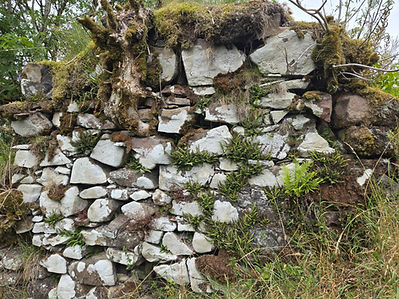
As of August 2025 nothing remains of the first floor as described by Alastair Maxwell-Irving and the vaulted basement has, unfortunately, continued to collapse resulting in the northeast wall giving way and exposing the remaining basement (see pics).

Blacklaw Tower ruins looking north from across the Blacklaw Burn
Exterior of basement walls looking north
Exterior of basement walls looking northwest
.jpg)
Interior of basement from now collapsed southeast wall

Interior of basement from now collapsed southeast wall


All sketches and a vast majority of this text was sourced from Alastair Maxwell-Irving's essential work, The Border Towers of Scotland - The West March, a must read for anyone interested in the subject.
Access to Blacklaw Tower

Accessing Blacklaw is not for the faint of heart as it involves a roughly 2 mile walk (red dashes on map at right) along a dirt road which is blocked by a gate (yellow star) at it's entrance. There is cell service so follow along to where the Blacklaw burn crosses the dirt road. Once there, the fun begins depending on the time of year of course. The above pictures were taken in mid August when all the undergrowth is no doubt at it's highest so once you leave the road, the undergrowth is about chest high and very difficult to press through. Unfortunately for us being there in mid August, most of the other structure remains are completely obscured by undergrowth, but some are certainly able to be detected.
55°20'43.7"N 3°29'45.1"W
